
You've screened dozens of conditions in your BioLector, analyzed the data, and finally identified the winning medium. Great! But one big question remains: Will it behave the same way in the fermentor?
Scaling up is often the moment of truth. A condition that performs perfectly at small scale doesn't always deliver the same results in a larger bioreactor. That's why validating your scale-up is such an important step.
With the Recipe Comparison feature in Constellab Bioprocess, you can answer this question in just a few clicks.
The application, which is pre-loaded with the data explored here, can be found here: https://constellab.community/apps/e1ec0c56-43a3-4b4d-a642-1ca4e555c8c9/constellab-bioprocess
Before you start
You'll need:
- A recipe containing your BioLector experiment.
- A recipe containing the corresponding fermentor experiment.
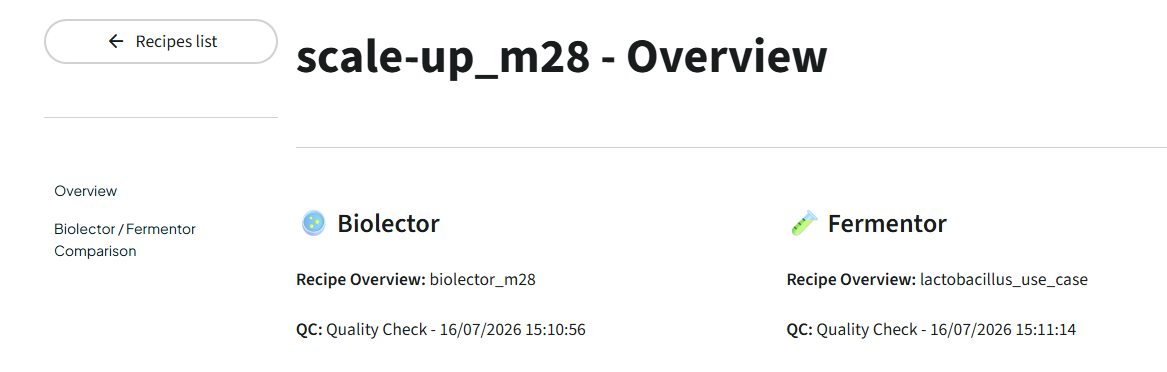
Compare your experiments
Create a new Recipe Comparison and select both recipes.
Constellab automatically combines the datasets into a single comparison, allowing you to visualize the performance of both experiments.
The proof is in the data
In our M28 comparison, the BioLector experiment showed excellent performance for Plate 1, wells C1 to C8. To validate the scale-up, we reproduced exactly the same conditions in the fermentor.
When we compare the biomass profiles from both experiments, the curves closely overlap.
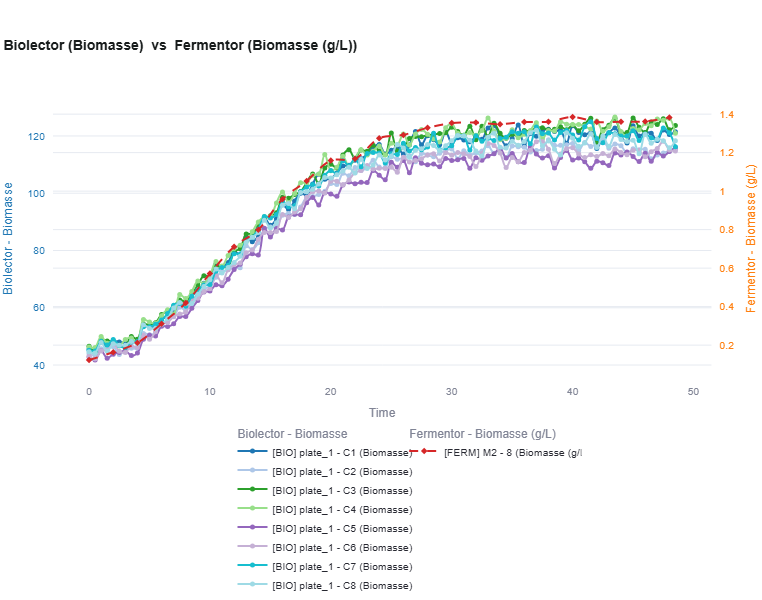
The result is immediate and easy to interpret: the cells follow the same growth behavior in both systems.
This is exactly what you want to see. Instead of wondering whether your optimized BioLector conditions will translate to production scale, you now have clear evidence that they do.
Ready to try it with your own data?
Add the Constellab Bioprocess app to your lab. You can find the full documentation here: https://constellab.community/bricks/gws_plate_reader/latest/doc/use-cases/constellab-bioprocess/e20dbf4f-72d5-49ba-b71f-730fc6cf9b49

Comments (0)
Write a comment