
About
🧬 Biota
Explore biological knowledge from multiple trusted sources in one centralized environment.
Biota is the biological and omics reference database of the Constellab platform. It brings together curated information from more than a dozen public biological databases, providing a single place to explore and connect compounds, reactions, enzymes, proteins, pathways, ontologies, and taxonomy.
Biota can be used directly through the Bio Navigator application and also serves as a reference layer for other Constellab applications and scientific workflows.
🔎 Explore Biological Knowledge
Biota centralizes several types of biological information that are usually distributed across multiple databases.
📊 Biota at a Glance
These biological entities are connected to each other, making it easier to move from one biological concept to related information.
🧪 Compounds
Explore 218,709 chemical entities and metabolites coming from ChEBI.
Compound information can include:
- chemical properties;
- biological identifiers;
- references to other resources such as KEGG and MetaCyc.
This provides a structured way to explore metabolites and connect them to other biological entities.
🔄 Biochemical Reactions
Biota integrates 14,002 biochemical reactions from Rhea.
Each reaction can connect:
- Substrates — 6,919 distinct compounds across 31,525 links;
- Products — 8,767 distinct compounds across 34,325 links;
- Reaction direction;
- Enzymes — 78,312 distinct enzymes across 96,185 links.
These connections make it possible to navigate between a biochemical transformation, the compounds involved, and the enzymes associated with it.
⚙️ Enzymes
Biota contains 111,868 enzyme records based on BRENDA and enriched with additional biological resources including:
- ExPASy;
- BKMS;
- ChEBI;
- BTO;
- NCBI Taxonomy.
ExPASy contributes 410 enzyme classes.
Enzyme records can be connected to:
- EC classification;
- taxonomy;
- tissues;
- pathways;
- other related biological information.
This provides a richer view of where an enzyme is found and how it participates in biological processes.
🔗 Enzyme Orthologs — Enzo
Biota also contains 6,911 enzyme orthologs (Enzo).
Enzo is a Gencovery concept that groups enzymes by EC number across organisms, making it useful for fast reconstruction of metabolic models from functional enzyme data.
🧬 Proteins
Biota integrates 550,000 reviewed protein records from UniProtKB/Swiss-Prot.
Protein records provide access to:
- protein information;
- gene information;
- taxonomic context;
- sequence data.
This allows protein information to be explored alongside other biological entities available in Biota.
🗺️ Metabolic Pathways
Explore 23,603 metabolic pathways and their relationships using information from Reactome and the Pathway Ontology.
Pathways can be linked to the compounds that participate in them, helping users move from individual molecular entities to larger biological processes.
🌳 Taxonomy
Biota integrates the NCBI Taxonomy, with 2,945,699 entries.
This allows biological information to be placed within its taxonomic context and enables users to navigate classification relationships across different organisms.
📚 Biological Ontologies
Biota includes four biological ontologies used to describe and organize scientific concepts.
Together, these ontologies provide 57,855 structured biological terms.
They provide controlled vocabularies and hierarchical relationships that help organize and interpret biological information.
🔗 Connected Biological Entities
One of Biota's key strengths is its ability to connect information coming from different biological resources.
For example:
🧪 From a compound to an organism
Compound → Reaction → Enzyme → Organism
🗺️ From a compound to a biological process
Compound → Pathway → Biological Process
Instead of searching each biological source independently, Biota provides a centralized knowledge layer where related entities can be explored together.
🤖 Bio Navigator
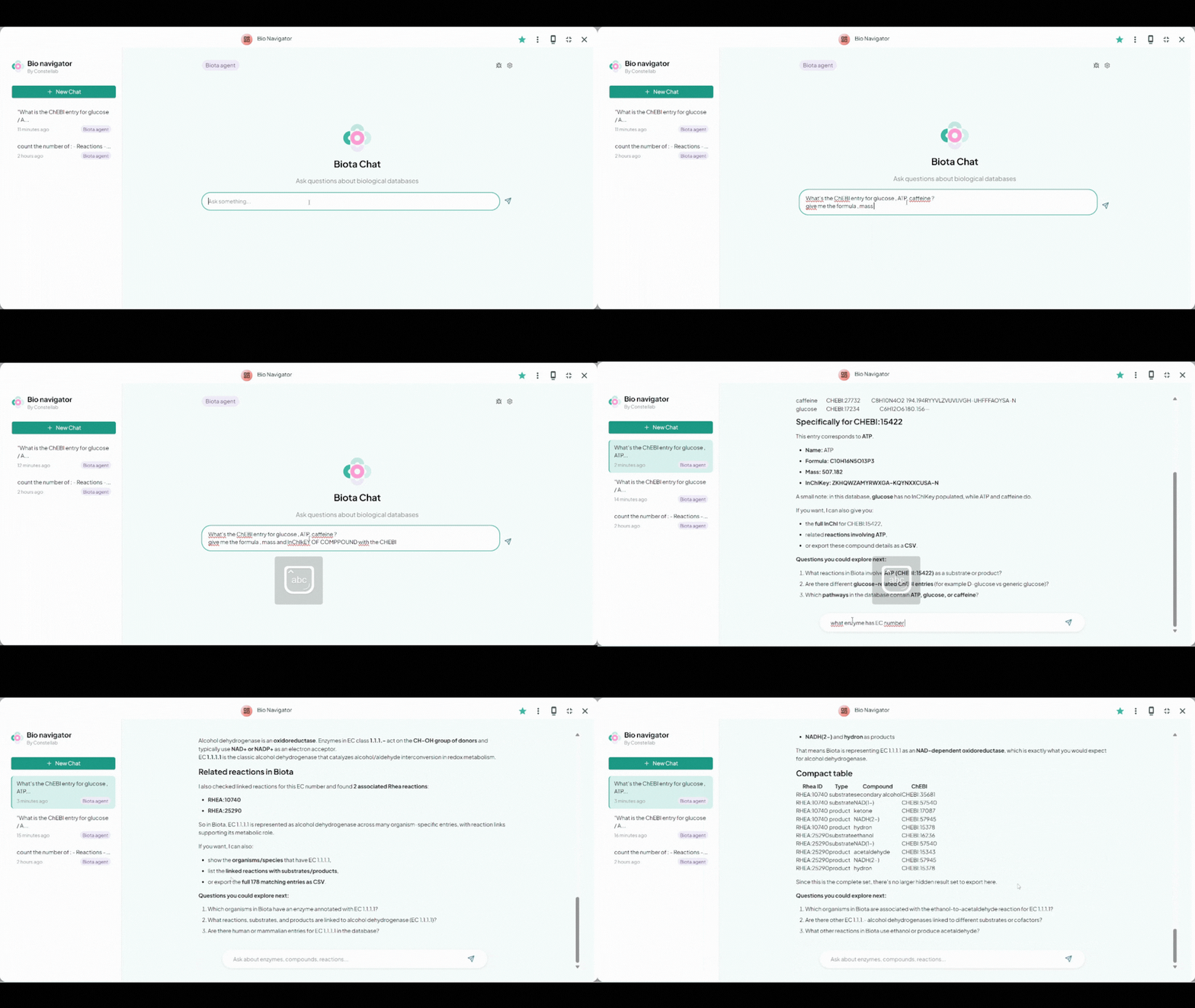
Biota includes its own Bio Navigator application.
Bio Navigator provides an interface for exploring the biological information available in Biota and includes an integrated AI chat assistant to support navigation and interaction with the database.
🧫 Supporting Metabolic Modeling
Biota is also used by other Constellab applications.
In particular, gws_gem uses curated reaction information from Biota to support the reconstruction of draft genome-scale metabolic models from an organism's NCBI taxonomy ID.
Biota therefore acts as a biological reference layer behind more advanced metabolic-modeling workflows.
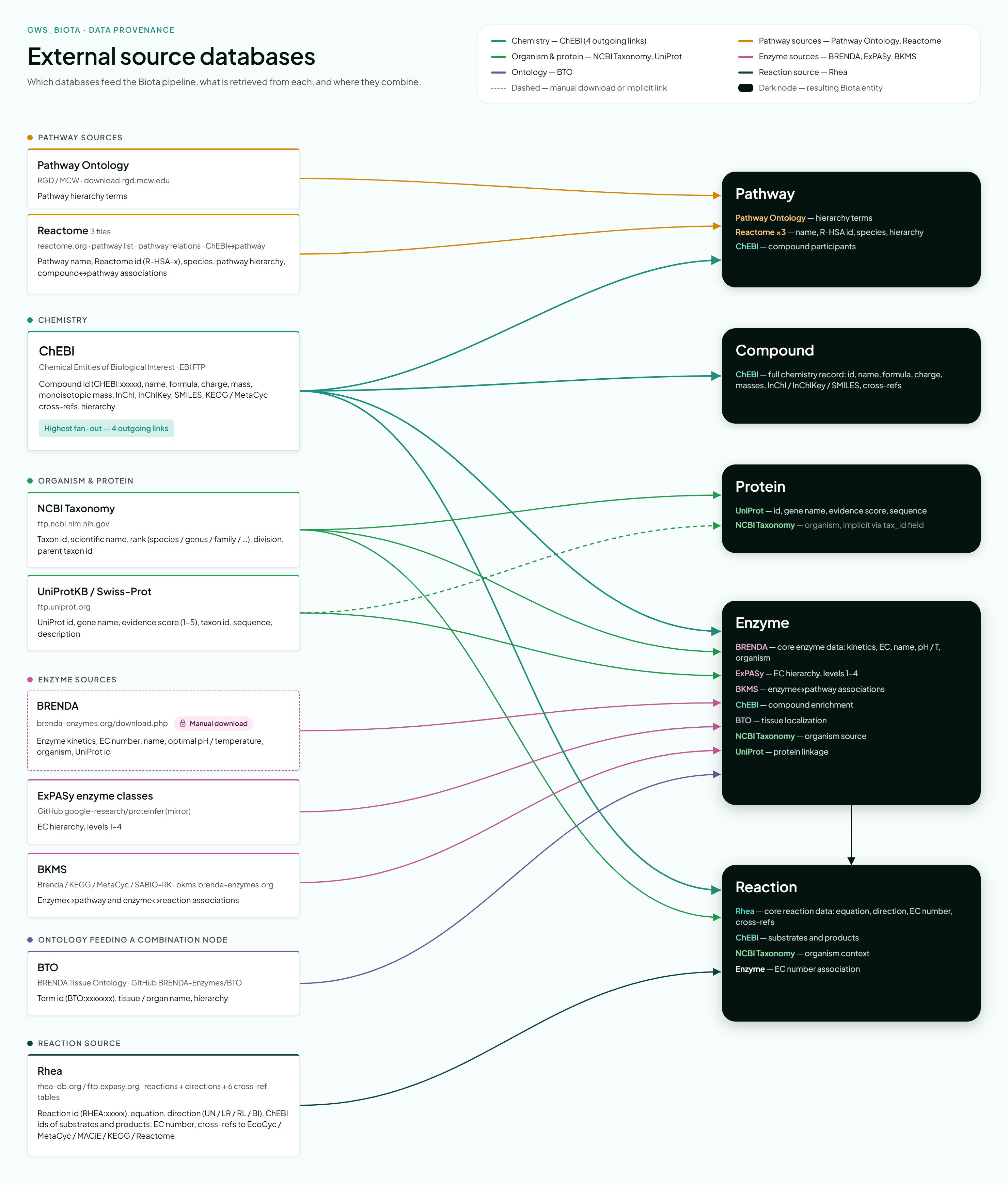
🌐 Multiple Biological Sources, One Database
Biota brings together information from established biological resources, including:
The result is a centralized biological reference database with nearly 3.9 million entries that can be reused across Constellab applications and scientific workflows.
✨ One Connected Biological Knowledge Base
Biota brings together three essential capabilities:
🧬 Biological Knowledge
Access compounds, proteins, enzymes, reactions, pathways, taxonomy, and ontologies.
🔗 Connected Information
Navigate relationships between biological entities instead of exploring isolated datasets.
🔬 Reusable Scientific Reference Data
Use the same curated biological knowledge across Constellab applications and modeling workflows.
By centralizing these resources within Constellab, Biota makes biological reference information easier to explore, connect, and reuse across scientific workflows.

Comments (0)
Write a comment